Canvaswork, Crazy January 2013 Challenge, Finishes, Little House Needleworks, Northern Pine Designs

Not one but TWO finishes!

I lived up to my word and poor old Flossy (well, she’s a babe really, to say she’s only been around for a week or two!) has been put on the shelf for now … the urge got to me yesterday and I spent the afternoon catching up on recorded TV while finishing off two of my WIPs I mentioned in my last post.

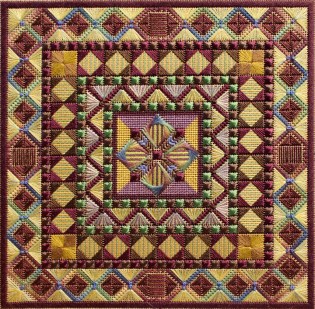
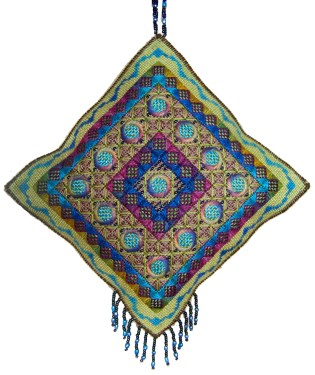
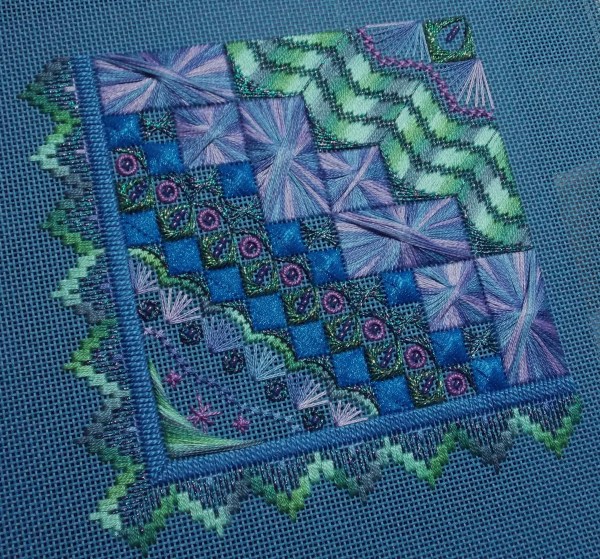
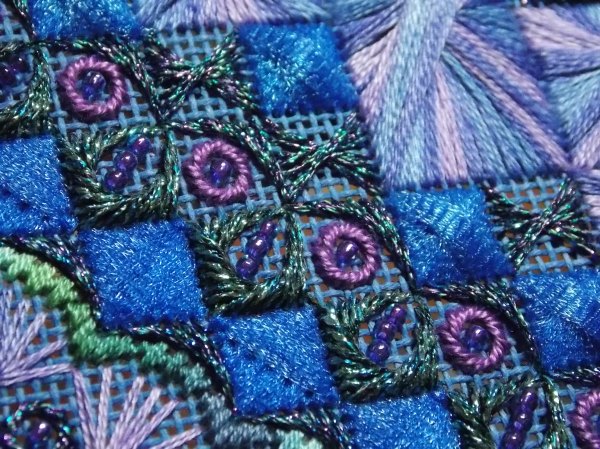
First up is Ebb Tide by Northern Pine Designs.  Oh boy, this was a fun design to stitch!  I can’t say I’ll be in a hurry to stitch with Rachel thread again, but once I got clever and used some nail polish across the top of the thread where I cut it, it was a lot easier to use!  It’s the first time I’ve ever done Jessica stitches, and they’re really quite cute, and easy to do once you get the hang of them!  I did them slightly differently to how the instructions told you to do them, as I’d seen them done on some other needlepoint blogs … by tucking the last two stitches inside and underneath the previous stitches, so they sit perfectly.  All-in-all I’m thrilled this one is finally finished … and I spent no time at all popping the next Northern Pine design onto the bars to start a new one!

DSCN0423

“Ebb Tide” by Northern Pine Designs
stitched on Leventeen Blue canvas
with recommended threads

DSCN0418

While I was trying to take a photo last night my camera was struggling a bit to focus … imagine my delight at the colours showing on the viewing screen when it will still a blur … it made me smile so I captured the image! 🙂

DSCN0417

Here is the next design ready for starting … just need to find a couple of the missing threads (geez I hope I actually have bought these ones, otherwise I guess it won’t be started soon! LOL).  If not, I’ll just have to find another canvaswork design to throw onto some bars … I think I always need to have a piece of canvaswork ready to go at a moment’s notice, it gives me such pleasure! 🙂

DSCN0425

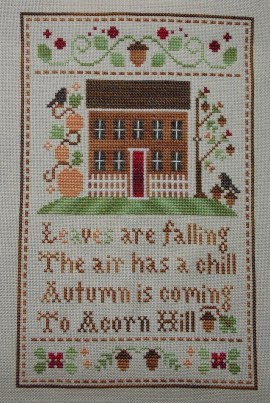
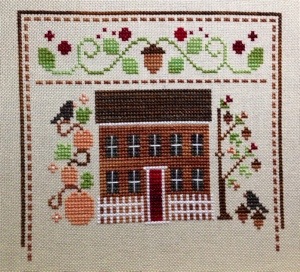
Then I decided to put the final stitches into LHN’s Acorn Hill – it didn’t take too long at all to pop the final words into place, and it became my second finish yesterday evening.

DSCN0427

“Acorn Hill” by Little House Needleworks
stitched on 28ct antique ivory coloured Jobelan 
with recommended Crescent Colours cotton floss

After that I decided to go back to old Flossy, and managed to put a few more stitches into the top wings – I didn’t bother taking a progress piccie as there wasn’t really too much to show … perhaps the next time you see her she will be finished … or maybe not … LOL.

Finishes, Freebies, Lizzie Kate

A few small finishes

Not much housework was done over the last weekend … instead I spent the weekend stitching a few small freebie designs, and a wee spot of baking on Sunday.  I’d been doing a bit of baking recently – Red Velvet Cupcakes last Monday to welcome my colleague back to work (and to celebrate being able to go back to a single person’s workload once again!).  Then I found out the same colleague has his birthday on Halloween, so I spent a few mid-week cooking hours in the kitchen making two fruit flans.  After this week’s delicious baking attempts I’ve now been officially dubbed “Team Chef” … but not entirely sure I want that title!! LOL.

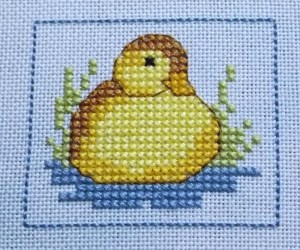
Last week I also managed to stitch a small chart I’ve had kitted up for a long time:

DSCN0365

“Duckling” freebie by Lesley Teare
(was on http://www.cross-stitching.com, but no longer there sorry!)

stitched on 28ct hand-dyed ‘sky’ Jobelan
with recommended DMC threads

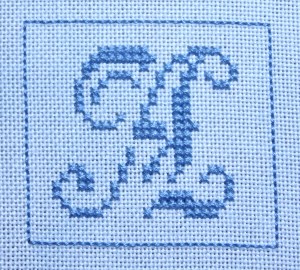
Then this weekend I decided to stitch a letter “A” on the same fabric to use as a backing for a scissor fob:

DSCN0369

Freebie chart from an old french Sajou chart (Sajou 361) – chart still available here
stitched on 28ct hand-dyed ‘Sky’ Jobelan
with DMC floss

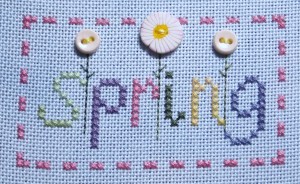
The other freebie stitching I managed to finish was as follows:

DSCN0368

“Spring” freebie by Lindy Lane Designs
(sadly it seems they are no longer in business, so I can’t provide a link to this one)
stitched on 28ct hand-dyed ‘sky’ Jobelan

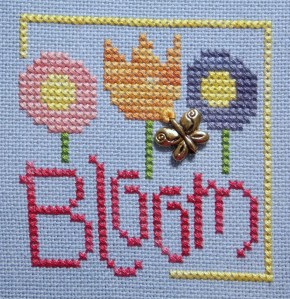
DSCN0371

“Bloom” freebie by Lizzie*Kate
Chart still available here (scroll down to the middle of the page)
stitched on 28ct hand-dyed Lugana (not sure by who, it’s a VERY tight weave!!)
with recommended GAST/WDW threads, with the exception of Harvest Moon
(I subbed with a Ltd Edition GAST thread)

As for what’s next?  I need to do one more scissor fob tutorial quite quickly to help out a fellow stitcher with a specific finishing method … otherwise I just might have to pick up a new start!  My latest order is on its way from 123stitch, which means my replacement thread for LHN’s Acorn Hill is on it’s way – I figure I can probably sneak in one more new start/finish before it arrives and I ‘have to’ concentrate on my WIP … haha, first time I’ve said that, that’s for sure!! 😛


Finishing, Focus on Finishing, Tutorials

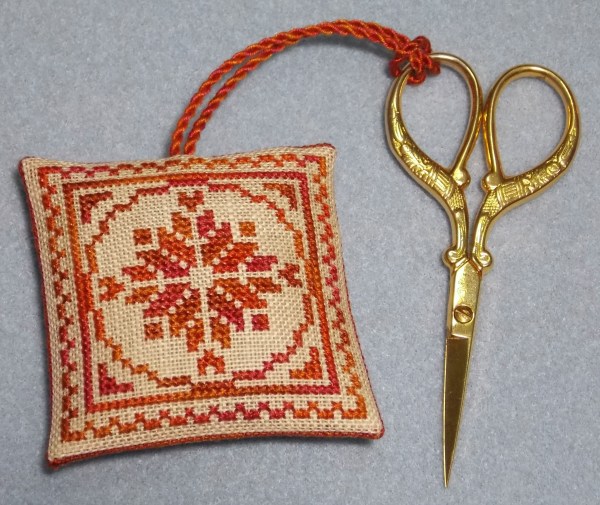
Scissor Fob Tutorial #3 (with whip-stitch edging)

This tutorial is the next in my list of the many ways you can finish a scissor fob. The whip-stitched edge is one of the most versatile ways to attach two stitched pieces of fabric together, and is the perfect stitch for finishing scissor fobs. The next tutorial will include a beaded edge and tassel … so watch this space for that one … and in the meantime I hope you find the below tutorial of use. As always if there is something that is unclear or you have any questions don’t hesitate to scream out!

Scissor Fob with whip-stitch edging

DSCN0404

You will need:

  • Stitching (identical size front and back)
  • Cording or ribbon for the hanger
  • Matching cotton floss for the whip-stitching
  • Your choice of filling (eg polyfil, teddy bear pellets, etc)

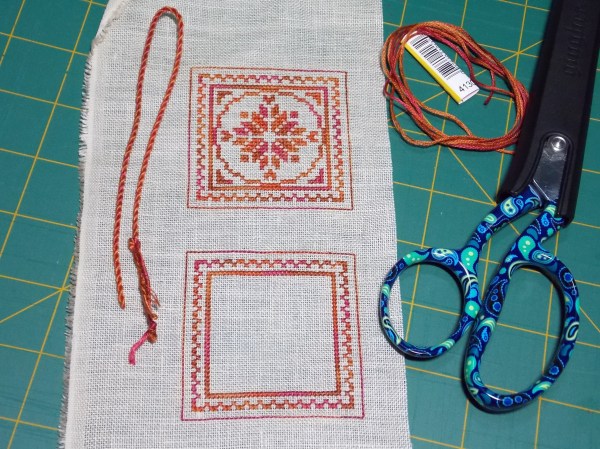
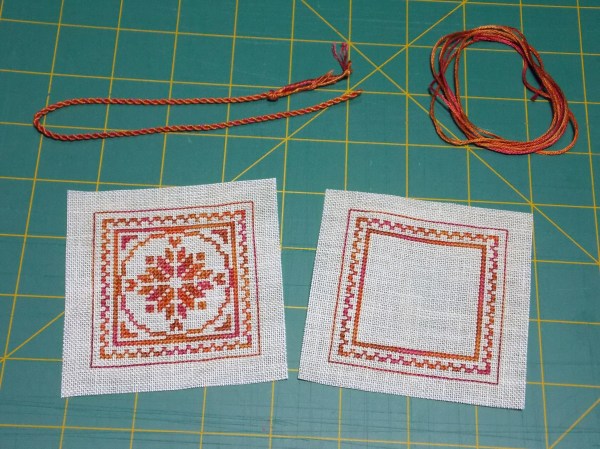
1. Firstly you need a back-stitched line of stitching outside your stitched pieces, both front and back. The stitching must be identical in size on both the pieces, so make sure you count very very carefully, or your sides won’t match when you whip-stitch the sides together. In most cases I stitch approx 2 stitches away from my main stitching (ie 4 threads away on linen and 2 squares away on aida fabric).

DSCN0372

2. Cut away the excess fabric from each piece, leaving approx 3/4 to 1cm seam allowance.

DSCN0373

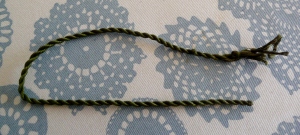
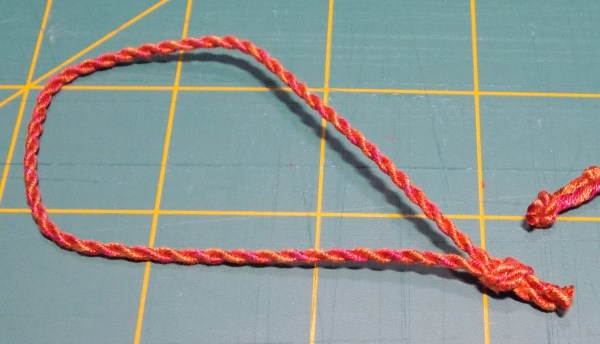
3. At this point I realised I hadn’t yet made myself a piece of cord, so I nipped off to quickly put a piece of cord together … see the previous tutorial for making your own cord. Alternatively you can use a piece of ribbon with the ends knotted together in the same way as the cord below.

DSCN0374

4. Now we need to turn over the seam allowance of your stitched pieces. First of all I fold over the corners right at the hole of the corner stitches of the back-stitched line.

DSCN0375

Then fold over the seam itself along the back-stitched line of stitches.

DSCN0377

DSCN0378

Continue all the way around until all the edges are folded over. You may prefer to hold down the seams with a pin – if you do this, though, don’t forget to pin it from the right side so you don’t accidentally stitch your pins on the inside of the fob!

DSCN0381

DSCN0382

DSCN0383

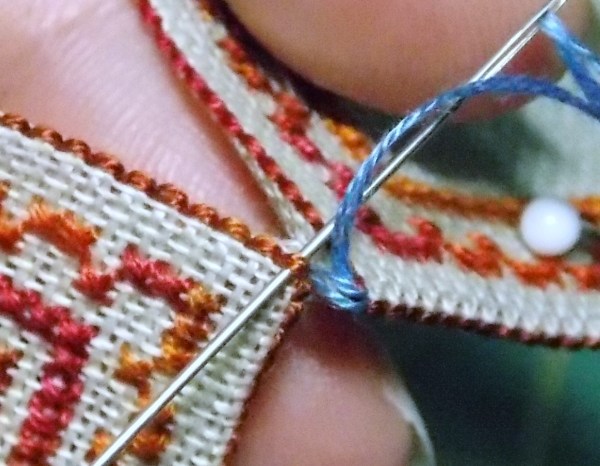
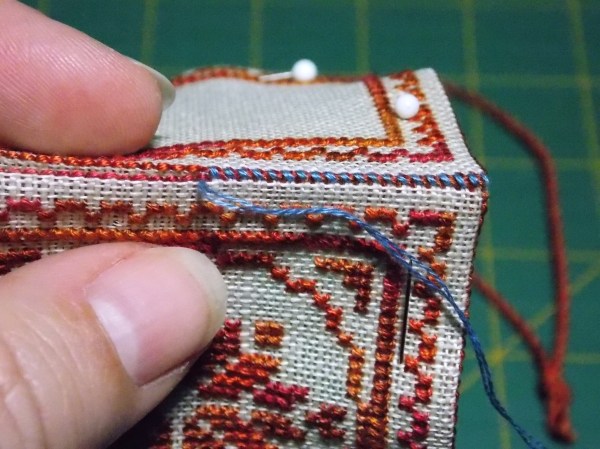
5. Now we start to back-stitch around the fob and stitch the front and back pieces together. I usually use 2 strands of cotton floss for my edges. Note that I have used a contrasting thread here so that the stitches show up more clearly – you can choose to do this if you want to have a contrast of the threads, but normally I prefer to use a complimentary thread colour to the fob, and usually use the same colour for the back-stitched seam lines and for the whip-stitching.

Start by coming up with your needle in the corner hole of one of the back-stitched lines.  I usually cheat and use a small knot to anchor my thread in the seam allowance.

DSCN0387

DSCN0389

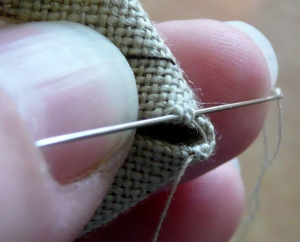
Then take your needle under one of the back-stitches – start with the first stitch on each side.

DSCN0391

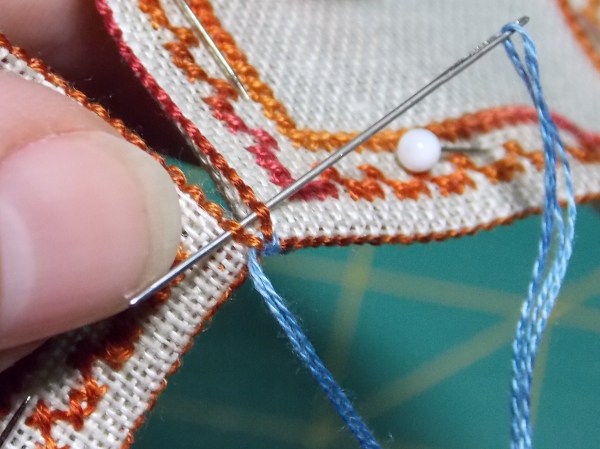
And continue to take it under the stitch that is directly opposite on the other piece of fabric (once again the first stitch on that side of the fabric).

DSCN0392

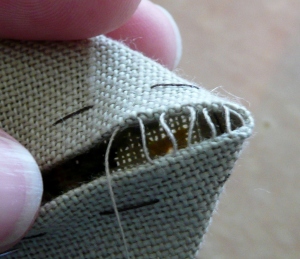
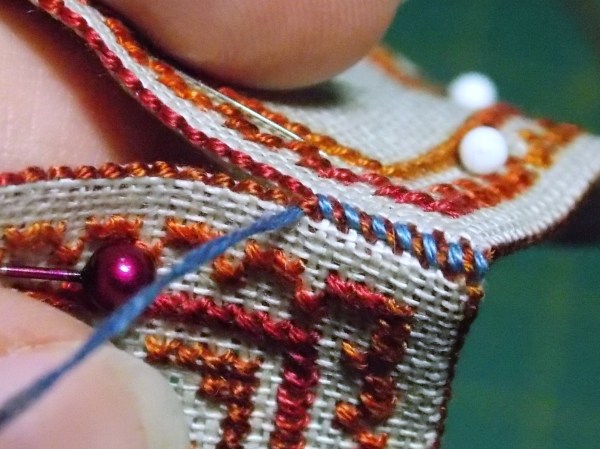
Then come back to the first piece of fabric, and take your needle under the next stitch and once again underneath the stitch directly opposite.

DSCN0393

DSCN0394

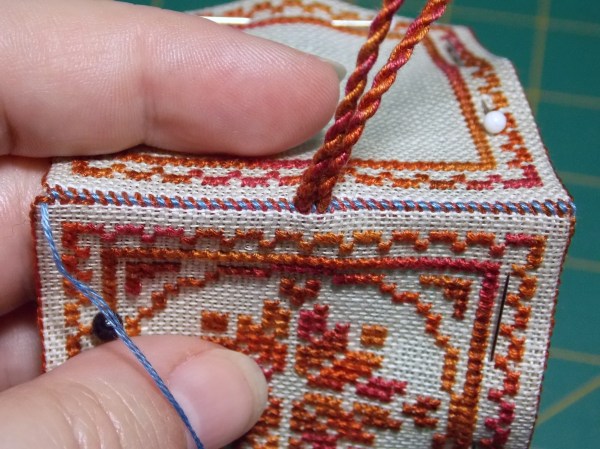
You continue this way until you come to a point where you want to attach your fob hanger. In this case I could have made my fob to hang in a diamond shape, or in a square shape … I ended up deciding on the square shape this time round.

DSCN0385

DSCN0386

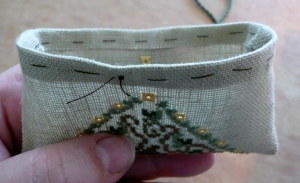
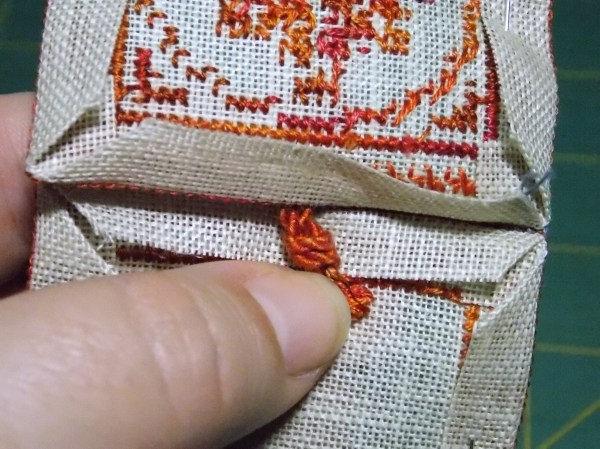
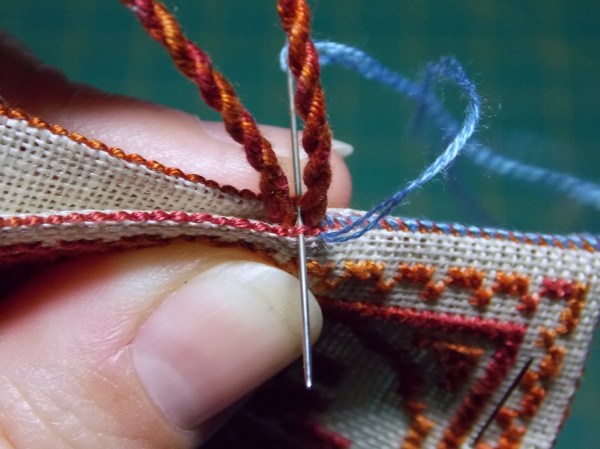
To do this I continued whip-stitching the seam until I almost came to the half-way point across one of the sides – then I inserted the knot of the cord into the seam.

DSCN0395

DSCN0396

DSCN0397

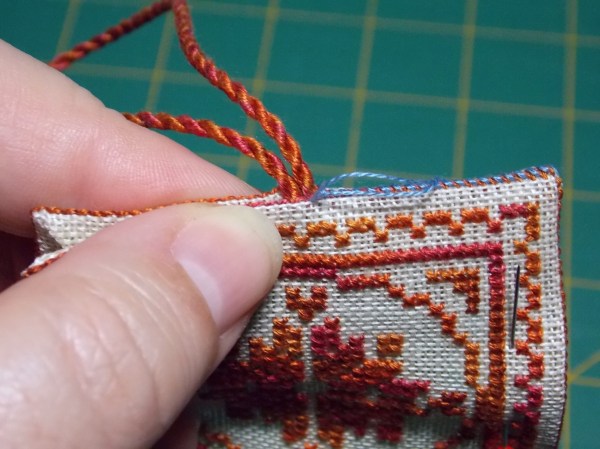
Continue to whip-stitch through each side of stitches, but for the next two stitches you’ll need to pass your needle through the centre of the cord as you stitch – this will ensure that your cord doesn’t come free and helps to cement it neatly in place.

DSCN0398

DSCN0399

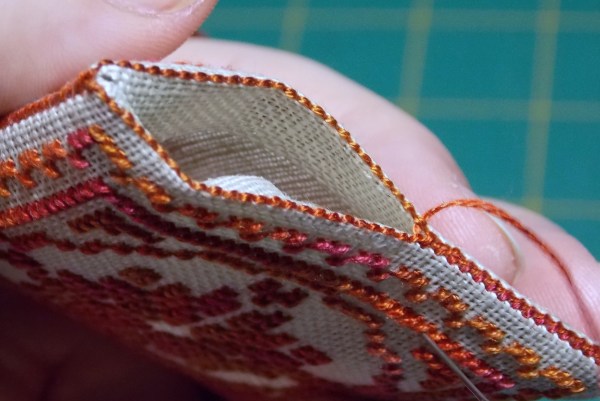
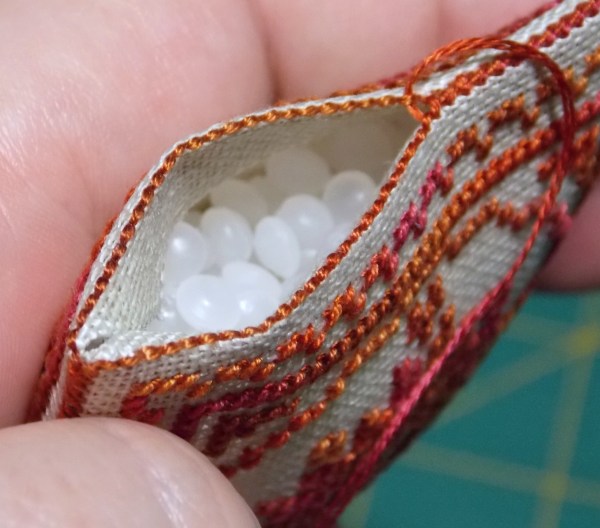
6. Continue to whip-stitch all the way around 3 of the sides, then leave a small opening on the 4th side so you can insert the filling of your choice. In my case I’ve used my favourite choice, teddy bear pellets.  (You will see that I’ve now started using the ‘proper’ coloured thread now to complete the finishing.)

DSCN0400

Once you have filled to your desired level, continue to finish off the remaining stitches.

DSCN0402

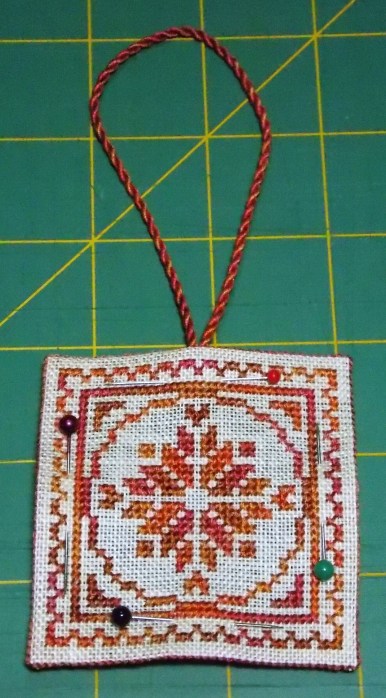
Finish off your thread at the end, and voila, your fob is all finished!!

DSCN0403

I hope you enjoyed the latest tutorial – thanks again for your previous comments on the other tutorials, it helps the motivation to keep doing more! 🙂

Finishing, Focus on Finishing, Shepherd's Bush, Tutorials

Scissor Fob #2 Tutorial (with corded edging)

This is the latest tutorial I’ve just posted on the Focus on Finishing blog … I hope someone finds it useful! 🙂

Scissor Fob #2 (with corded edging)

This time round the scissor fob I’ve chosen is a simple pillow with a corded edging.  I think it is better to use a home-made cord for this, as it is softer to manipulate, but you can always try to use purchased cord if the home-made cord intimidates you too much!

P1080011

Materials needed:

  • Your chosen stitched piece, including a front and back
  • Polyfil stuffing or other stuffing of your choice (eg teddy bear pellets or crushed walnut shells)
  • DMC pearl cotton or cotton floss for cording
  • DMC cotton floss for attaching the cord
  • Sewing needle (either a sharp or tapestry needle)
  • Pins and scissors

P1060958

1.  First of you you need to cut the front piece of your stitching into the desired size.  I find the easiest way is to count the number of threads when using linen or the number of holes when using aida.  In this case I followed the design’s suggestion and counted out 25 threads from the stitching, then I pulled out the next thread – this makes a clean line for you to cut the excess fabric away.  Then once all 4 sides of the front piece have been cut, place it face down onto the back piece, with right sides of the stitching facing each other, and cut out the back to be the same size (don’t forget to make sure the back piece is centred correctly before starting to cut – I usually do this by holding the two pieces up together in front of a light source such as a bright window).  Pin the two pieces together.

P1060960a

P1060961

2.  Sew a seam around the edges, but leave an open gap at the bottom seam to allow you to turn it inside out and add the stuffing.  I usually leave one long tail of the sewing thread that I use for sewing up the opening at the end.

P1060962

P1060963

3.  Cut away the corners, but don’t cut too close to the stitching, otherwise it may unravel when you turn the piece inside out.  Then trim back the side seams a little so they aren’t as bulky when turned inside out.

P1060964

P1060965

4.  Turn your stitching inside out.  You may want to ease the corners with a chopstick or something similar for a crisper ‘point’ at the corners – be careful, though, so you don’t make holes in the corners (yes, that’s the voice of experience talking from my first attempt years ago!).

P1060966

5.  Now it’s time to stuff with your choice of stuffing material.  In this case I’ve chosen Polyfil, and once again I use a chopstick to ease some of the stuffing gently into the corners.  The amount of filling you use is down to personal preference – I prefer mine not to be over-stuffed, but firm enough to feel ‘full’.

P1060967

P1060968

P1060969

6.  Next you close up the opening in the bottom seam.  My preference is to use a ladder stitch, however you can use a whip-stitch if that is easier for you.  To do a ladder stitch you just work your way alternatively up each side of the seam, taking a few threads in your needle for each stitch – this looks like the rungs of a ladder when the stitches are loose, and when you pull them tight they close up the seam very cleanly.

P1060971

P1060972

7.  Now it’s time to make your cording.  To do this you’ll need to have quite long pieces of thread, and I used 3 strands of pearl cotton that was supplied with my scissor fob kit.  Details of how to make cording yourself can be found in Scissor Fob #1 Tutorial.

P1060973

8.  Firstly you need to fold your cording in half and place a knot at approx 3 1/2″ to 4″ from the end.  Of course you may prefer a longer hanger, so feel free to make it as long as you want, just as long as you have enough cord to go around the edges 🙂

P1060975

P1060976

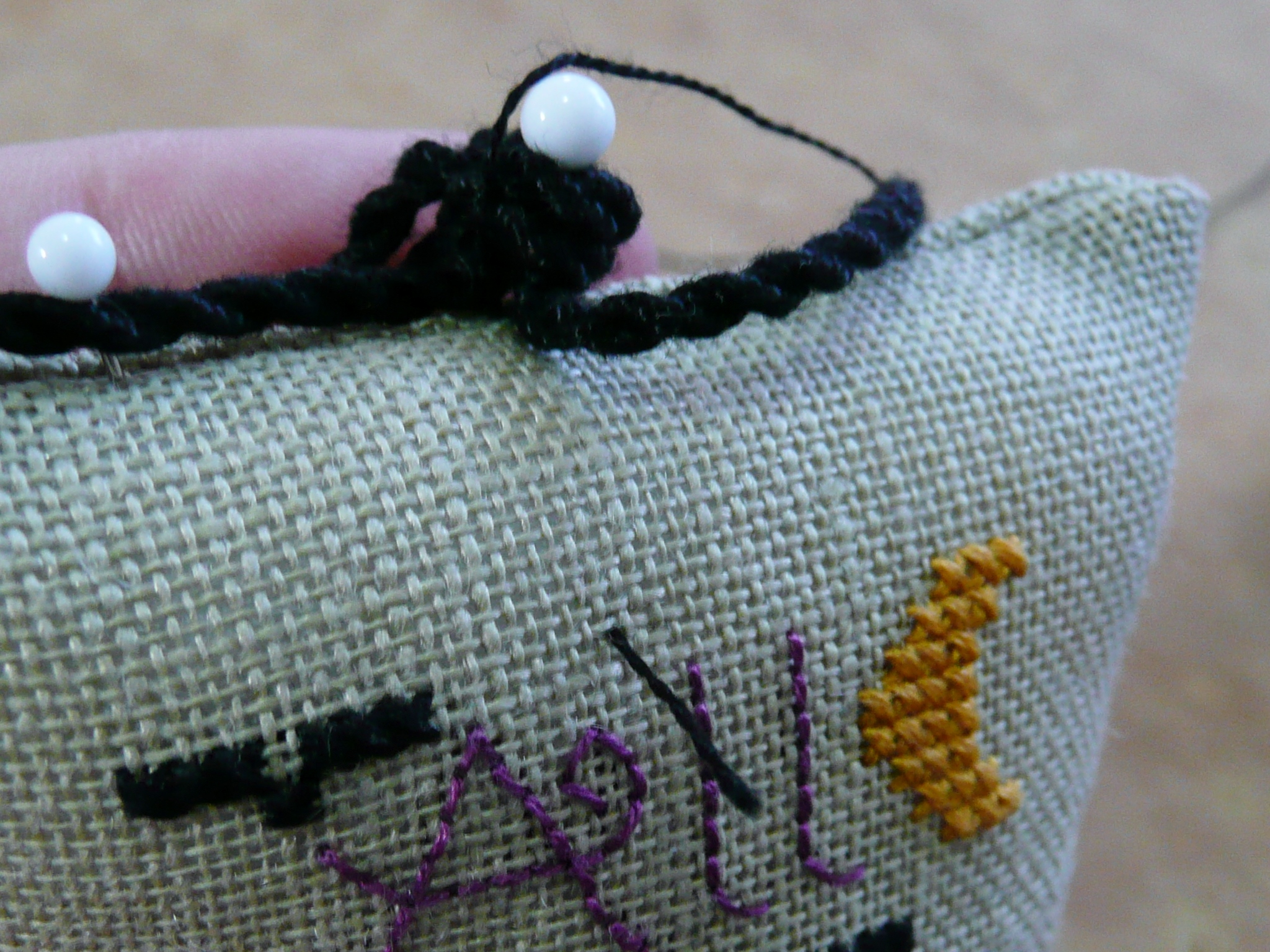
9.  When we start to attach the cording around the edge of the scissor fob ‘pillow’, I find it easiest to place a pin through the centre of the cord knot and take it down into the pillow at the centre of the top seam.  From there I take the cord along the top seam and add two more pins to hold the cord in place temporarily.  I start off my thread by poking my needle through the top of the pillow, through the stuffing; pull the needle so the thread just disappears from view under the fabric, then add a few little catch stitches at the back of the knot (because I’m using black thread you can’t see these stitches, if you’re using another colour where the stitching thread shows up, you may want to do your catch stitches underneath the knot out of sight).

P1060984

P1060985

P1060986

P1060987

Bring your needle to one side of the cord and take a small stitch under the seam – I try to put my needle in about 1 thread away from the seam, and come up approx 1 thread away from the seam on the other side, so it’s less likely to be seen.  (I pulled my knot up out of the way to show you the stitches, which pulled my loose tail out, so you need to be careful if you do this yourself!)

P1060989

P1060990

Now you take your needle and thread over the top of the cording to the right-hand side once again, and this time put your needle through the fabric just in front of the next twist in the cord.  You should use the cord as your guideline here for the length of your stitches – your top thread should follow the ‘furrows’ in the cording and sit neatly in the shape of the cord.

P1060998

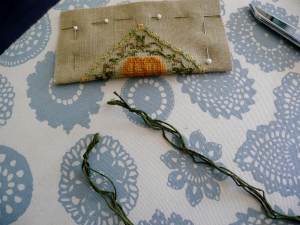
Unfortunately it’s quite difficult to see this with the black thread, so I have use another piece of cord with a contrasting thread as an example so you can see more clearly what I mean …

DSCN0335

My cord is a dark colour, so I prefer to use the above method to attach my cording – sometimes, though, if you’ve used a variegated thread, or if your cording is a lighter colour, you may prefer to attach the cord with a small stitch underneath the cord attaching it to the fabric.  To do it this way you just need to take your needle through the cord at the bottom the cord:

DSCN0339

Then take your needle through the fabric seam underneath the cord, bringing the needle through on a diagonal … then continue the same way until the cord is attached.

DSCN0341

DSCN0342

Now after that little cording detour, it’s back to finishing off the scissor fob …

At this point you can remove the pins once your stitching is well underway.  Continue stitching the cord around the edge, stopping at the centre of the bottom seam.

P1080001

P1080002

Now go back up to the top of the cord and do the remaining side the exact same way, and finish off your thread by taking a couple of small stitches into the cord.  Once again I ‘bury my thread’ by taking my needle into the pillow and coming up a wee way away and cutting off the thread flush with the pillow fabric … then you just give your pillow a quick squeeze and the end of the tail disappears.

P1080004

P1080006

P1080007

Lucky last, I pop a quick knot at the base of the pillow, and the scissor fob is finished 🙂  If you find your cording is too long, just make another knot at your desired length of each piece of cord, and cut off any extra length not required.

P1080008

10.  All that is left is to attach your fob to your chosen pair of scissors!

P1080011

I hope you have found the tutorial useful – if you happen to use any of the information I’d love to see your projects where you have used them 🙂

Kindest regards,

Crazy January 2013 Challenge, Little House Needleworks, Works in Progress

Acorn Hill

After finishing Trick or Treat I couldn’t face going back to do the beading on my mermaid or the blended needles on my TW so I opted for an easy stitch that I’ve wanted to do for years … I’ve always adored the warm colours of this one and it hasn’t disappointed at all – it’s been a fun stitch so far. I’m at the halfway mark now so it’s time to roll up the scroll bars to start the bottom half. Sadly, though, my usual stitchers curse has appeared again and I’m going to run out of the Brown Sugar thread … b*gger! Never mind it’s an excuse to kick myself into gear to place a thread order 😉

20131013-110112.jpg

Finishing, Scissor Fobs, Shepherd's Bush, Stitching Smalls, The Drawn Thread

Preview of the next tutorial

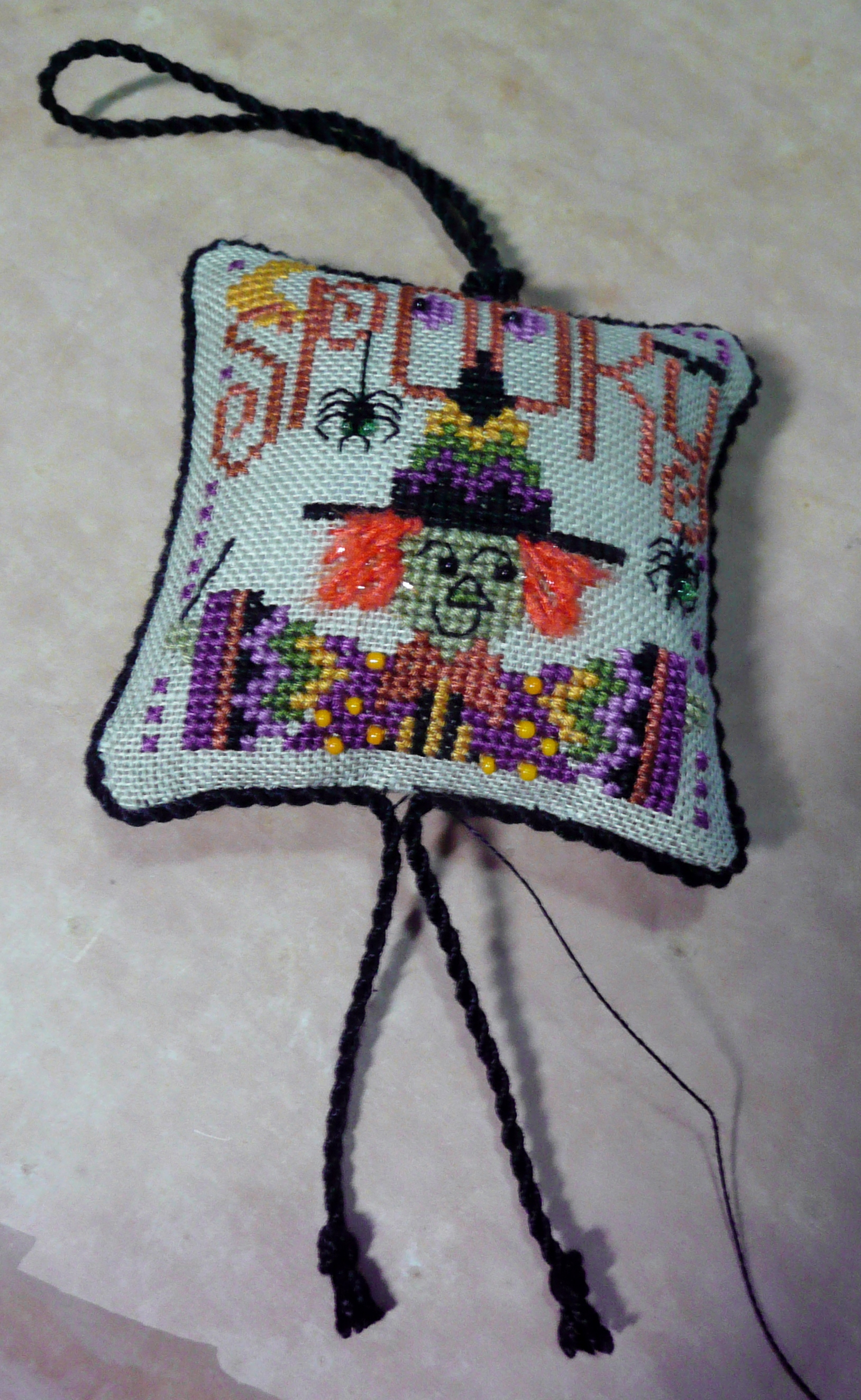
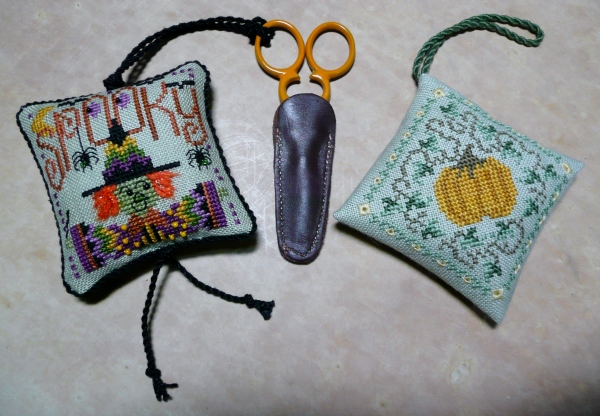
Yesterday I had a mini finishing spree where I did all the photos needed (almost all anyway!) for two scissor fob tutorials.  As you can see from my previous post I managed to complete one of them and have it published … I want to take some more photos before I publish the second one, though, so the cord attachment is more clear.  In the meantime, however, I can share my two finishes from yesterday – so you have a preview of which fob finishing method is coming next … 😉

P1080012

It’s felt really good doing the tutorials once again … perhaps my finishing funk is slowly disappearing and a wee bit of mojo is returning? … I really do hope so! 😀


Cross Stitch, Finished Items, Finishing, Focus on Finishing, Scissor Fobs, Stitching Smalls, The Drawn Thread, Tutorials

Stitching Tutorial #1

I have just published the following tutorial in my Focus on Finishing blog, but thought I’d include it here as well …

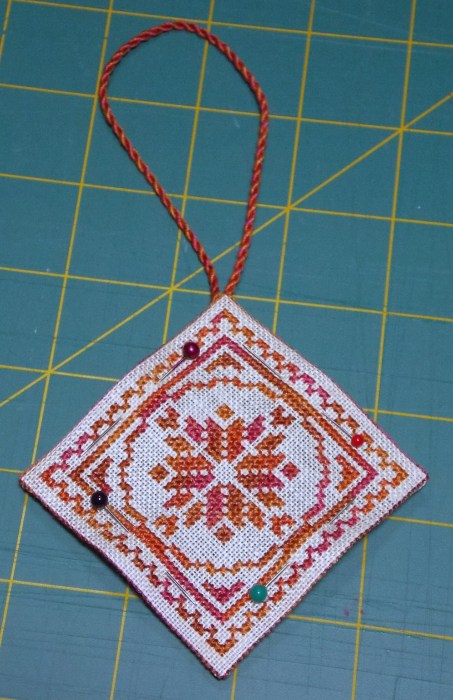
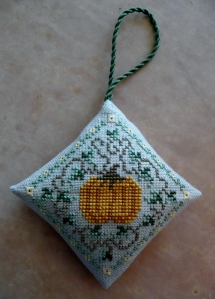
This is the first of a number of upcoming Scissor Fob tutorials … and is the type of finishing used by The Drawn Thread freebie designs and similar to Mill Hill treasure ornament series.  The finish is a diamond shape, which I think is really attractive for a scissor fob.  This one in my tutorial is a bit large for a scissor fob, in my opinion, but the finishing is the same irrespective of the design size you choose 🙂  If you are interested, this is Pumpkin Keeper freebie by The Drawn Thread.
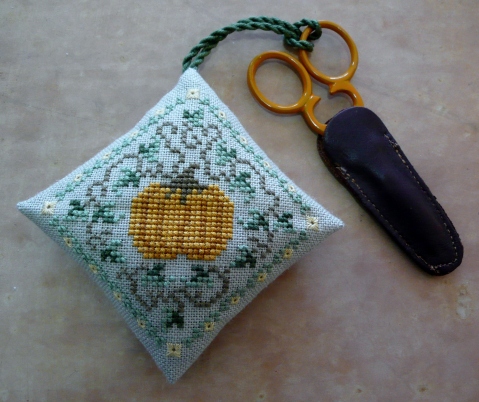
P1060957

Materials needed:

  • Stitched project – this needs to be a square design, preferably stitched in a diamond shape
  • DMC thread or sewing machine thread to match the stitching fabric (and contrasting sewing machine thread for basting, if desired)
  • Stuffing (your preferred choice, can be Polyfil, crushed walnut shells, or teddy bear pellets, for example)
  • DMC for cording, or ready-made cord
  • Pencil or cording drill

1.  Ensure you have equal sides on your stitching – the easiest way to do this is to count the number of squares away from each of your piece if stitched on aida, or count a specified number of threads away from each side when stitching on linen.  In this case I followed the Drawn Thread instructions, which was to count out 24 threads away from the stitched area and cut off the fabric edges.  I find the easiest way to do this is to count out your designated number of threads then remove the next thread, ie pull it all the way out – this leaves a clean channel for cutting a straight line following the weave of the linen, as you can see in the photo below.
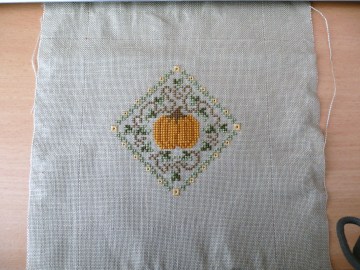
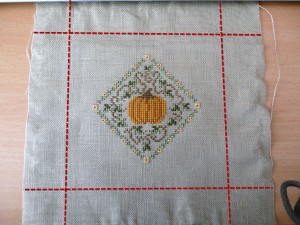
P1040636

P1040636

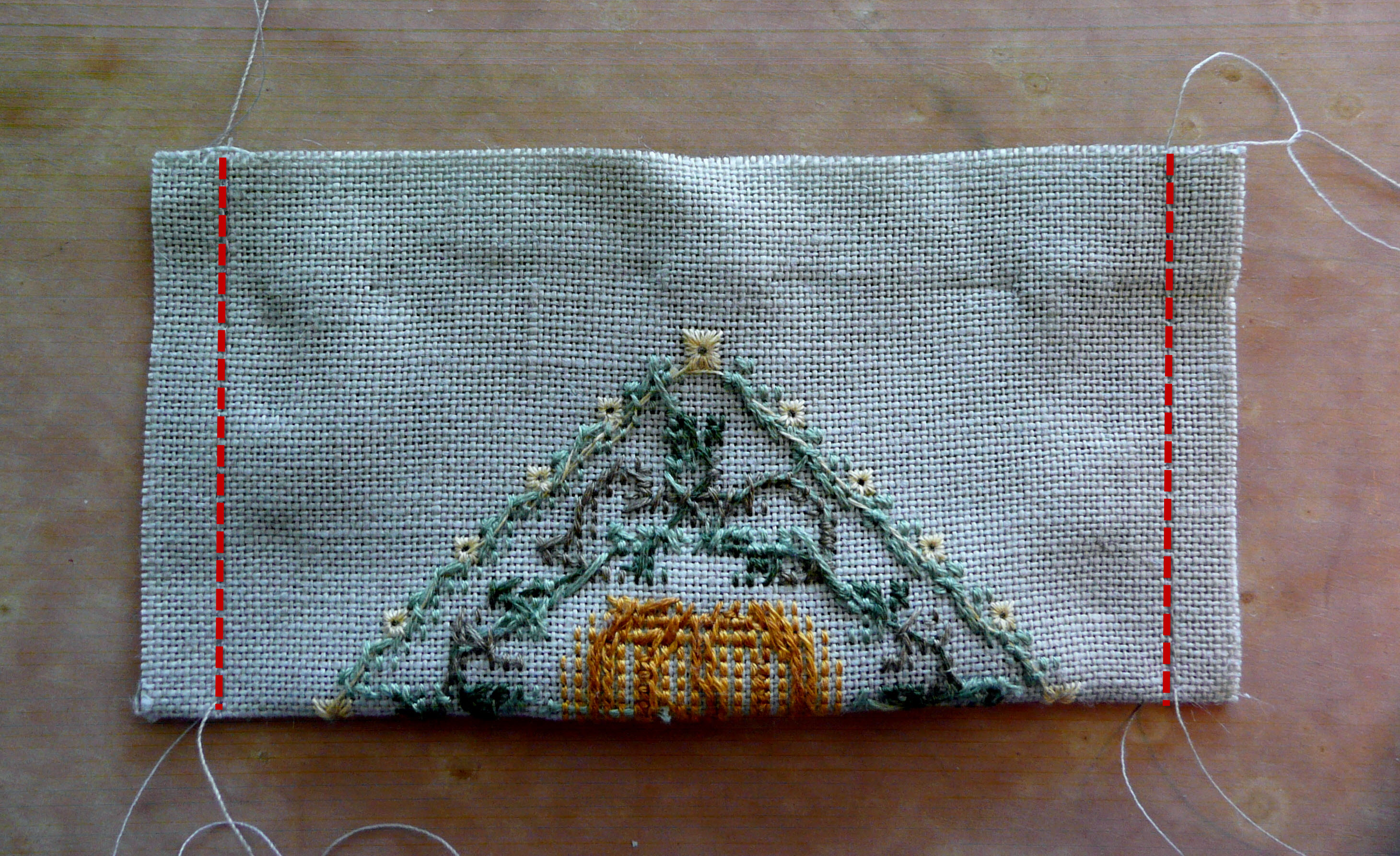
2.  Once you have cut away your edges and have a nice square piece of fabric, fold your stitching in half across the centre of the design, with the right side of the stitching facing each other.  Pin the edges together, and stitch a seam allowance at each of the short edges.  As it is hard to see my thread on the fabric, I have highlighted with red stitching where the seam line is below.
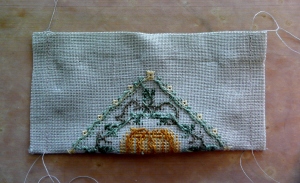
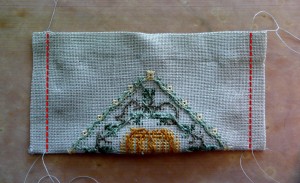
P1060927

P1060927a

I usually prefer top snip the corners slightly to make them easier to make ‘points’ once they’re turned the right-side-out.  If you do this, make sure you don’t snip them too close to the seam line, or it will unravel, and you don’t want that!
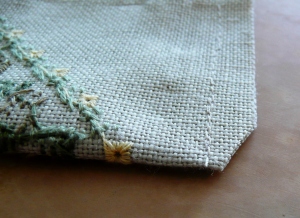
P1060928

3.  Now turn your stitched piece inside out, and put out the corners – sometimes I use a pointed chopstick to help get a nice point in the corner, but this needs to be done gently so you don’t poke a hole in the fabric!
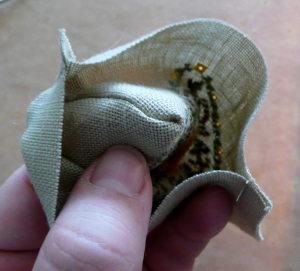
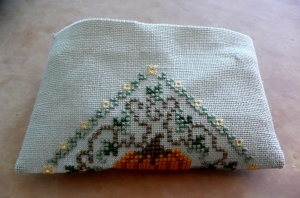
P1060930P1060931

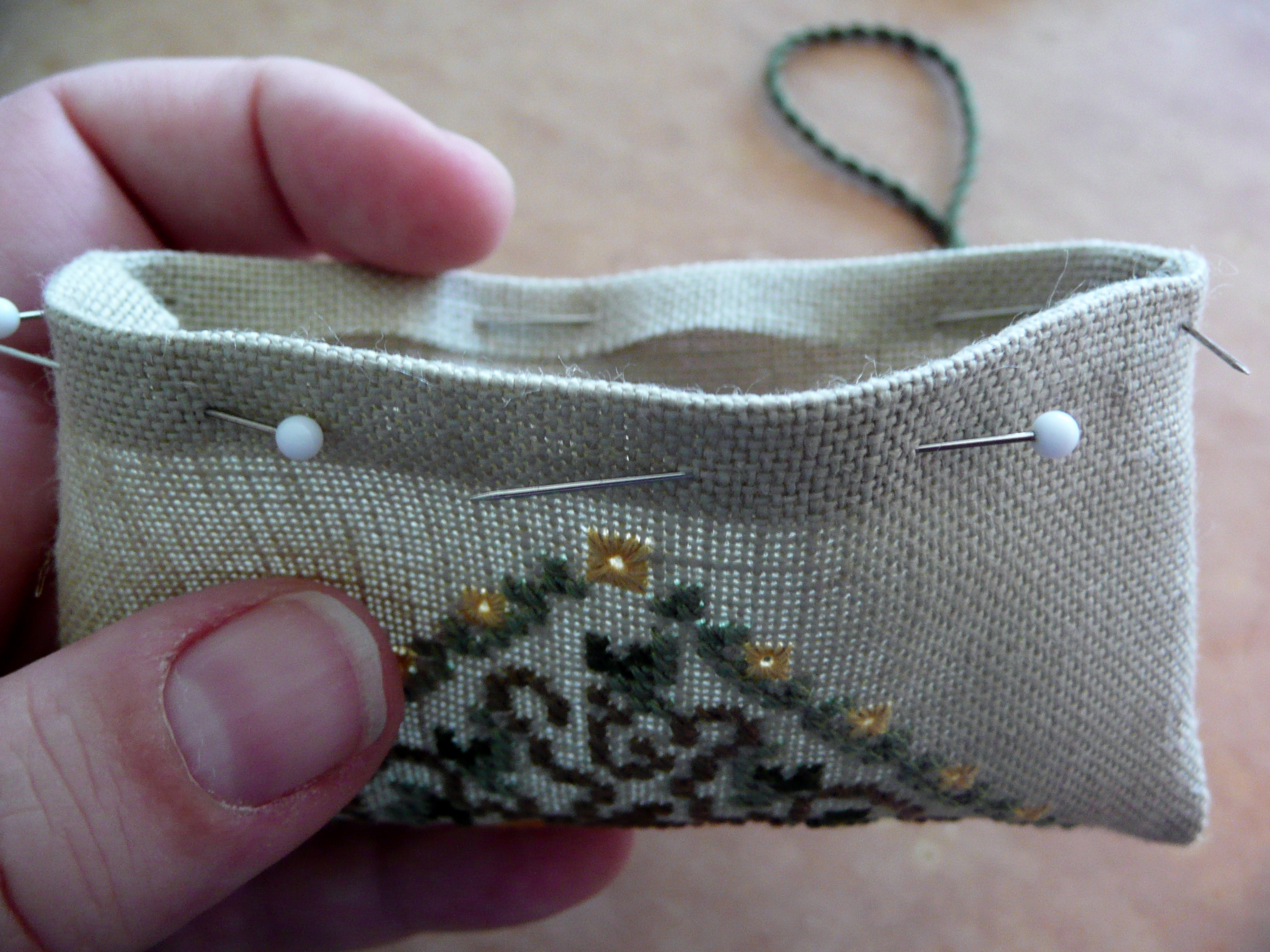
4.  Next we turn over the seam allowance on the top raw edges.  I prefer to give the seam a quick iron to make it sit flat.  You can just pin the seam allowance down around the top, or do as I do which is to baste it down using a contrasting sewing machine thread.
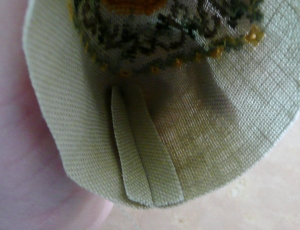
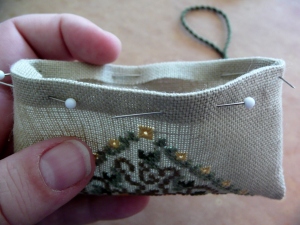
P1060932P1060933P1060935

5.  Next bring the two seams together to meet in the centre, and your stitching is in a diamond shape.  I usually pop a couple of pins in temporarily to hold the seams in place.  Turn your piece over to work out which is the top of your stitching, and where the cord will eventually be attached.  In this tutorial, because the fob is so big I’ve decided to just have a cord hanger at the top without any tassel or embellishments at the bottom – another tutorial will cover the option of adding tassels to your fob later.
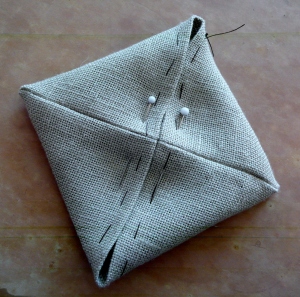
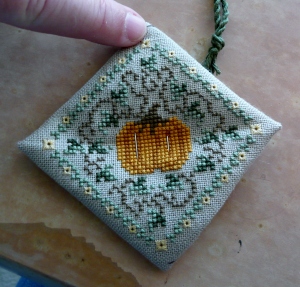
P1060936P1060938

6.  Next it’s time to make your cord – obviously if you have purchased ready-made cord you can omit this step, but ensure your purchased cord is quite narrow so you can knot the ends easily.  I made my cord out of DMC cotton floss, and because of the size of the fob I opted to use 4 strands of DMC for my cord as I wanted it to be a bit thicker (my preference is usually 3 strands of either DMC or pearl cotton).  Sometimes it’s trial and error as to how thick the cord will turn out.  It is generally much easier to have another person assist you in making cord, but as I’m on my own I have to improvise with whatever is handy!  I apologise in advance for the poor photos in this section, I will do another tutorial soon to show the steps more clearly …

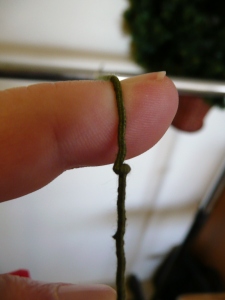
The first thing to do is to knot each end of the group of threads together.
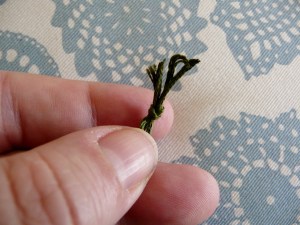
P1060894

P1060898

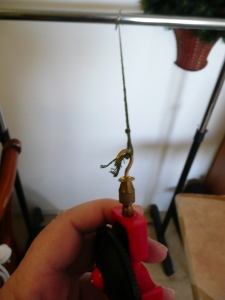
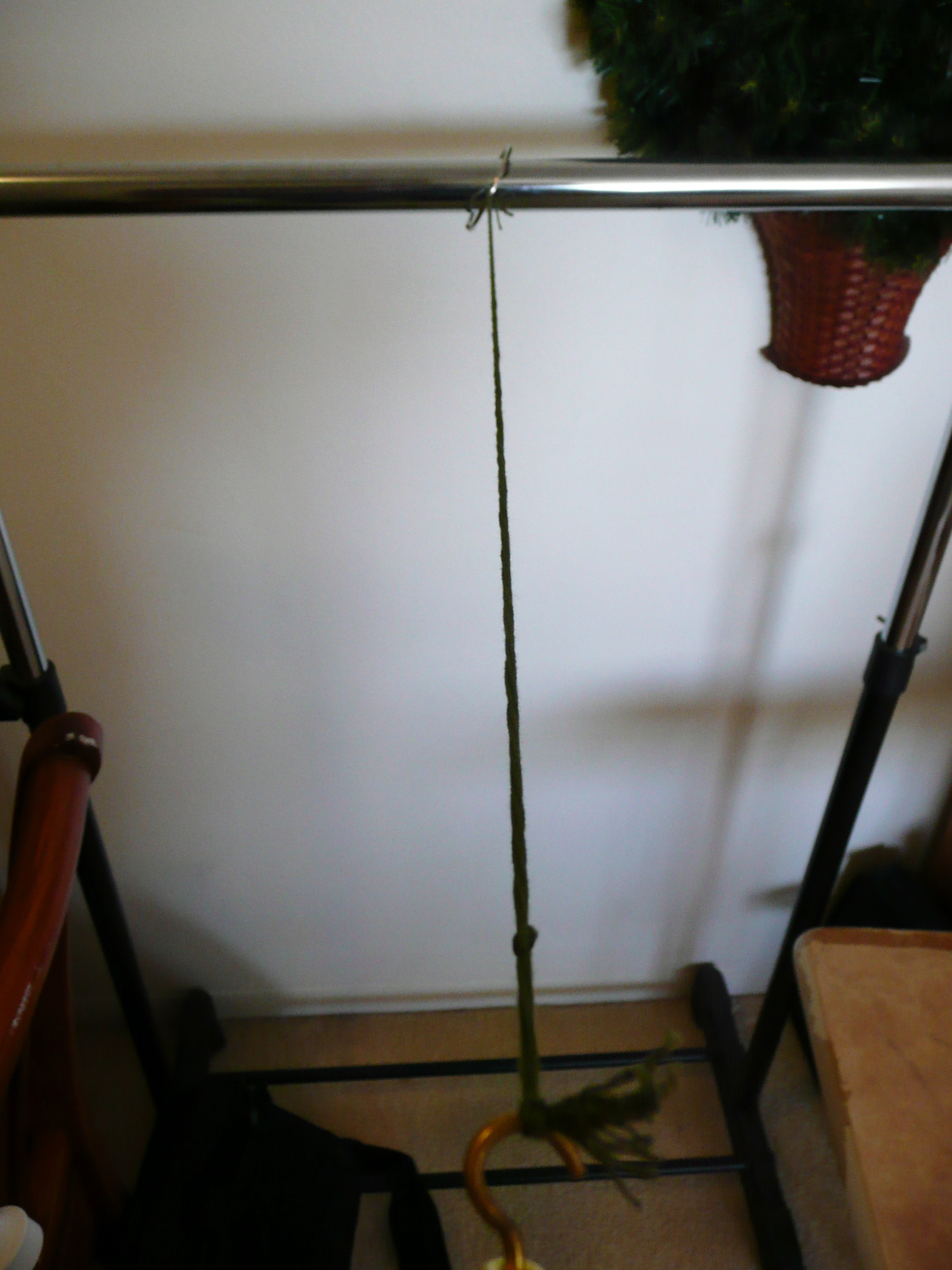
Next you need to rope in an assistance to help out by holding one end of the threads tightly, or do what I do by finding something you can attach the other end to … in my case I have a portable clothes rack that I used, by snapping a metal ring over the rail and hooking the ring through the middle of the threads at the knot end.  Alternatively you could tie the end around a door handle or something similar.
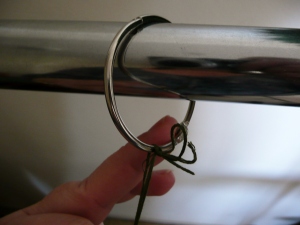
P1060899

If you have a cord drill, that’s perfect, otherwise you can make do by using a simple pencil to wind the thread.  Take your pencil and insert it through the middle of the remaining end of the thread (at the knotted end), and walk back until your thread is nice and straight.  Then start turning your pencil – it doesn’t matter in which direction you turn your pencil, as long as you continue to turn it the same way 😉  I prefer to use a cord drill as it’s so much quicker, so that’s how I finished my cord off this time round.
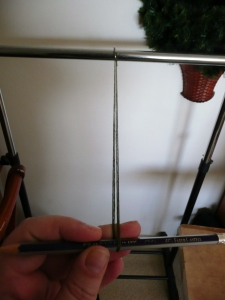
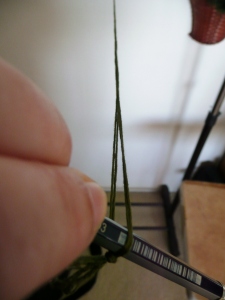
P1060900P1060901P1060911

You need to keep turning your pencil/cord drill until your threads are very taut.  If you slacken off your tension a little bit and your thread starts to ‘kink’ and turn on itself it’s generally twisted enough.  I let go of the tension a little bit here so I can hopefully show you what I mean about the ‘kinking’ of the thread.
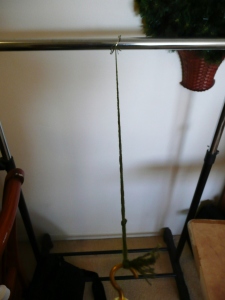
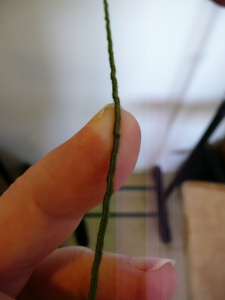
P1060913P1060915P1060917

This next part is very tricky to photograph as I needed both hands …  Once your thread is twisted enough, carefully hold the middle of your twisted thread with one hand, then using your other hand bring the two knotted ends together.
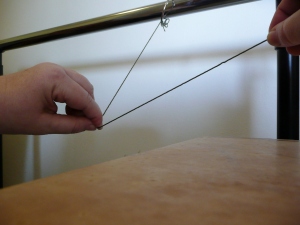
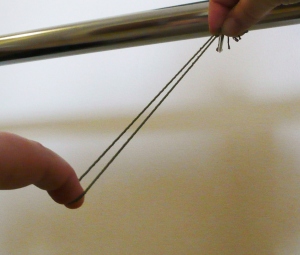
P1060918P1060921

I usually use a self-made weight that I hang in the middle, but forgot to use it this time!  I’ll show that method another time, as it’s a really quick way to get the threads twisting onto themselves!  In this case, however, I just used my left hand (my right hand was still holding the two ends together) to slide up the thread about an inch, and using my thumb and forefinger gave the threads a gentle twist.  You continue to do that by working up the thread and helping the threads twice nicely onto themselves.  Eventually you end up with a beautifully twisted cord.  Then you finish off by knotting the two loose ends together so it doesn’t unravel.  And voilà your cord is finished!! 😀
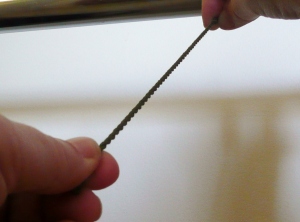
P1060923P1060924

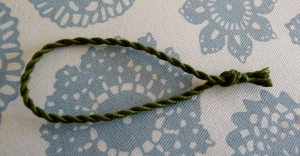
7.  Decide how long you want your cord to be – generally 3 1/2 to 4 inches is about the right length, but you may prefer to have your hanger longer than that – it’s all personal preference!  In this case I’d made my cord quite short so I could do the tutorial easier for you.  Knot the two loose ends together at your desired length.
P1060925

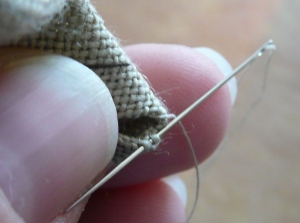
8.  Now it’s time to pick up your stitching once again, and we need to start stitching up the remaining seam.  My preference is to close it up using a ladder stitch, however you can use a whip-stitch if that is easier for you.  Start at the bottom of the fob, away from where the cord will be inserted.  To do a ladder stitch you just work your way alternatively up each side of the seam, taking a few threads in your needle for each stitch – this looks like the rungs of a ladder when the stitches are loose, and when you pull them tight they close up the seam very cleanly.  Keep stitching up the seam until approx 1″ away from the end.
P1060942P1060944P1060946

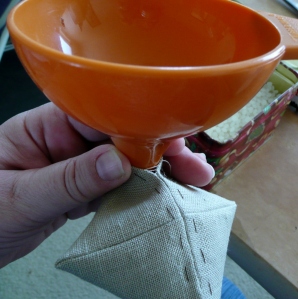
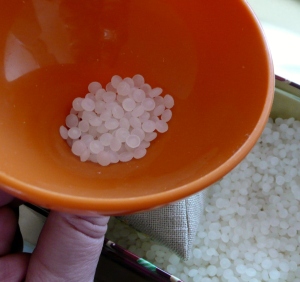
9.  At this point you insert your chosen stuffing.  I have opted to use teddy bear pellets for mine, as I really like the extra weight it gives the fob, especially for smaller fobs (in hindsight I probably should have used Polyfil for one this big!!).  When I stuff with pellets I use a little Tupperware funnel that I find really useful for this job – alternatively you can roll a piece of stiff paper into a funnel instead!
P1060947P1060948

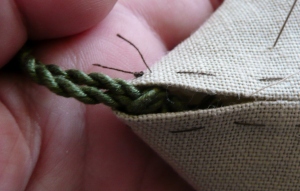
10.  Now we’re on the homeward stretch, and it’s time to add the cord and close up the seam!  Take your cord, and place the knot inside the seam opening, then continue stitching up the opening to the top.  Sometimes I will take my thread through the cord at the top to stop it from moving around, but it wasn’t needed for my fob this time.  You can now remove all your basting stitches.
P1060953

And that’s it, your fob is all finished and ready to adorn your chosen pair of scissors!!
P1060956

As always, please feel free to leave comments and let me know if you have any questions.  It’s always good to know if you find the tutorials useful, or if there is something you would like to see more of, so the comments are always appreciated!

Kindest regards,

Brown House Studio, Canvaswork, Christmas Ornaments, Cross Stitch, Northern Pine Designs, Works in Progress

A touch of vertigo and stitching

Finally my work project launched recently, but not until I’d had a few weeks of really long hours – including a 2am finish and a few 10-11pm finishes in the final week.  To say I was a touch mentally and physically exhausted at the end of it all is definitely an understatement.  My boss very kindly offered for me to have a few days off work in lieu of all the extra hours I put in … so I decided to take 3 days off at the start of last week, 2 days of which were in lieu from the previous month’s project … only to fall ill on day 3.  I had a wonderful couple of days off where I managed to stitch up a Christmas ornament, and did a whole lot of cooking for the freezer … but then on day 3 I woke up with severe vertigo, and have been bed-bound for almost a week since then.  The last couple of days I’ve managed to sit up in bed and watch TV, but I have only managed to walk over to the doctor’s surgery once yesterday, and came straight back to bed again …  I did, however, manage to put a few stitches into a canvaswork project – it was a nice calming distraction, and didn’t tax the eyes too much with the nice large holes in the canvas etc.

971819_10151604537623148_1334514417_n

“Folk Art Topiary”  ornament by Brown House Studio (2004 JCS Xmas ornie issue)
stitched on 28ct Golden Needle Country French linen
with recommended Crescent Colours threads

1185043_10151604537588148_1598849201_n

“Ebb Tide” by Northern Pine Designs (work in progress)
Today I’m going to attempt to try and finish off another ornament already started, but in truth the fabric holes are really hard to see, so I may give it up as a bad joke pretty quickly … but if nothing else I’ll be catching up with the final episodes of Season 3 of True Blood … I hadn’t watched any of them before, but they were ‘free’ to watch on Quickflix (as part of my monthly membership), so I’ve been glued to the gogglebox watching all 3 seasons over the last couple of days … it looks like seasons 4 and 5 are on there too, so I know what I’ll be doing for the next week or two … I knew there was a good reason to up my internet quota, I’ve certainly been making good use of it at the moment, that’s for sure!!

Canvaswork, Round Robins, Shepherd's Bush, Stash, Works in Progress

Stash galore – and a new start

Over the Christmas period while I was at my parents’ place Mum and I went a little crazy with some major sales (ie 40% or more off) happening.  In some ways you could say this was my Mum’s Christmas gift to me, as she gifted me with a “Visa card repayment” which meant I had some additional play money while I was there.  I hadn’t realised really just how much I’d ordered until it all started turning up last week! LOL.  There is still one parcel yet to see, as I sent it to Mum’s address, thinking I was staying there for Dad’s surgery – so I’ll have an extra little treat waiting for me when I return (assuming Mum hasn’t put it somewhere “safe” never to be seen again LOL).  Anyway, without further ado here is the MASSIVE pile of stash that arrived, which also managed to clear off a number of items that have been on my wishlist for years!

P1060685

P1060684

P1060683

P1060682

P1060681

As for stitching, my needle has been very scarce these days – I did have a sudden urge to stitch a few nights ago and opted for the first thing I could find that was already kitted up, was relatively small, and basically could be ready to stitch at a few moments notice (considering I made my “let’s stitch” decision at 9pm at night!!) … I ended up choosing one of the Shepherd’s Bush scissor fobs from my original Crazy January Challenge list.  I still haven’t finished it yet, but I was very good and marked up my rotation spreadsheet to make sure I’m still allocating the right times to each slot.  The front is completely finished, and I just have to complete the back and it’s done 🙂

P1060686

Next up, though, is to start (and hopefully finish) my Round Robin piece – which are the Seasonal Topiaries by Passione Ricamo.  This was originally published as a set of freebies on the internet, but I think they’ve been long since taken down, and the design has since been published in a magazine.  I’ve decided to stitch mine on a piece of hand-dyed Pipi Belfast by Countrystitch … and seeing as it’s due to be posted out on 1 February, you know what I’ll be doing the entire long weekend this weekend (thank heavens for that extra day so my goal feels slightly more achievable!).

And on that note, I’ve ironed my piece of fabric tonight ready to start, so I think I’d better so drag the tub of DMC out and start finding the colours I need.  Mind you, in actual fact it doesn’t really matter if I don’t 100% finish my section, as long as I complete all the border pieces … “she’ll be right”!  This is a link of what my round robin will look like – and I love the added verse at the top of the sampler so much that I’ve ‘stolen’ the idea and will be doing the same thing with mine too … the only difference is that I’m moving the Winter tree to be on the left to make the sampler a teeny bit more balanced 🙂

Crazy January 2013 Challenge, Cross Stitch, Finished Items, Finishes, Flowers Trees & Gardens, Frangipani, Goals, Pay It Forward, pincushions, scissor fobs, Stitching Smalls, The Floss Box

It’s a woman’s prerogative…

No sooner had I set out my stitching plans for 2012 that I started to realise I really don’t know how in the hell I’m going to achieve all of those finishes/goals when I really only get to stitch on the weekends (and not every weekend at that) … so I’m seriously thinking of throwing those previous plans out the window, and just going back to a rotation instead.  That means I’ll also be able to focus more on my existing WIPs which are actually starting to bother me, rather than trying to cram in those same WIPs (at a lot slower pace than I’d like) as well as meeting all the SAL and commitment deadlines at the same time … and probably not getting any of them done by the year’s end (but not stressing about it).

Perhaps it’s just that my head is in the wrong space at the start of the year with Dad’s health and some work issues that are still really bothering me.  Both of these issues are slowly getting resolved, with Dad seeing his surgeon this Friday, and I’ve started having dummy spits in the office to voice my frustrations at issues I’m facing (including telling a team member they’re doing my head in and they’re not helping my stress levels … yep, there have definitely been a few dummy spits lately in that respect, and probably a couple of months well overdue at that!!).  Anyway, maybe removing the pressure of having to finish all these projects will help to restore some sanity to my stitching – most of the projects in my list will still remain there as part of the rotation, I will just have no expectation to actually complete them by the year’s end … plus I’ll have the opportunity to change my mind at a moment’s notice, as I’ve also come across some other projects that I really wanted to stitch, but that didn’t make the cut for my initial 15 projects …  I think the stress of only limiting my stitching to a set group of projects also inhibits my sense of freedom, and as soon as that sort of pressure starts mounting I find I don’t end up stitching at all … so perhaps it’s for the betterment of my stitching this year to just ‘let it all hang out’ so to speak 😉

Tomorrow I’m off to the local GP to try and get some antibiotics for my bugs, which will also help to bring me back to a state of equilibrium (and probably less likely to have dummy spits at work LOL) … and perhaps feel more like stitching … but in the meantime I’m going to start my rotation guilt-free just as soon as I’ve finished my Round Robin piece that’s due out for mailing at the end of January … but not before I have fun by adding a few more rotation projects to the pipeline 🙂

And I’m not stressing if I change my mind a million times throughout the year … as the title of this post says, “it’s a woman’s prerogative” … as long as I enjoy my stitching this year I’m happy 😀

section divider

Ooh, before I forget, I heard from Cindy that my little gift arrived safe and sound when she returned from holidays – so I can now share the full goodies … just as soon as I find the photos!!!  I think I’ve shown the finished biscornu before, but I’ve never shown the finished fob that matched it.  It feels good that this is now finished and living in its new home 🙂

section divider

While I’m at it, I think there are also a number of framing jobs that I completed in November last year that I haven’t shared on here yet … the Tiger and Summer Snapperland are both for me, whereas the bears and the Letter S are both for gifts.  I did most of the framing of the Tiger 2 years ago, but couldn’t finish-finish it as the backing board was too high … he’s one of my first ever finishes (stitched on aida) and I love, love, love him!

P1060581

P1060548

P1060559

P1060577

P1060580

section divider

Finally here are a couple of yummy things I brought back from New Zealand with me on my last trip – the scrumptious blug electric kettle was compliments of Mum and Dad’s Fly Buys points in NZ, while the bowls are from my ‘glory box’ still in storage over there.  Both have already been christened, and I’m totally in love with the jug in particular!!  And I can’t WAIT to try out the new Orange Truffle Baileys over a bucket of ice … hmmm, in fact I just may choose that for dessert tonight, the ice will help soothe my throat and the alcohol will help to lull me into sleepy submission … hmmm …

P1060661

P1060666

P1060664

The final photos are of my frangipani plants on my balcony to show Mum – now both plants have finally flowered, although I’m disappointed to see the 2nd plant which has flowered for the first time has the pink frangipani … it’s still very pretty, but I do have to admit to preferring the white frangipani on the whole.

P1060667

P1060669

P1060670

And I think that will do me for another post … I still have some other things to post yet, but think I’m a bit photo heavy already … and it’ll give me something to write about later (if I get over the shock of having so many blog posts in one month!!!).